
FEATURE FABRIC: SILK & SILK BLENDS

Featured Silks From our Website
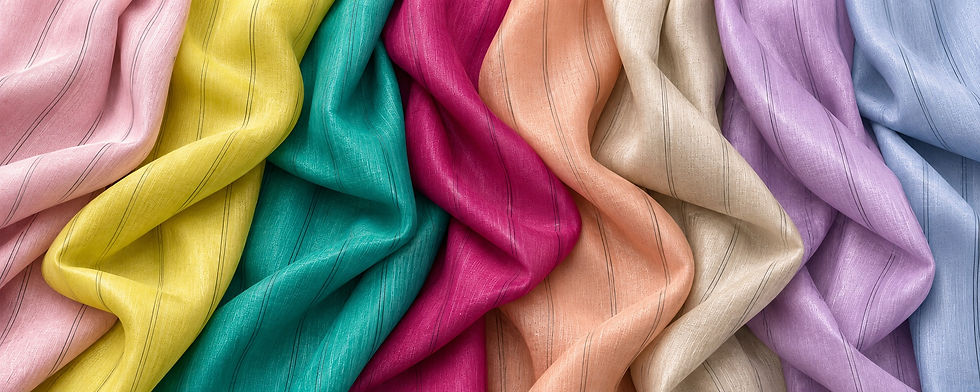
There are few fabrics quite as evocative as silk. It can be whisper-light and almost transparent, softly washed and relaxed, crisp and sculptural, or rich with a beautiful fluid drape.
And while we tend to think of silk as something reserved for special occasions, it is actually an incredibly versatile fibre. Mixed with cotton, linen, viscose or other fibres, it can become easier to wear, easier to sew and much more suited to everyday life.
A Few Fascinating Things About Silk
Silk is a natural protein fibre, most famously produced by the silkworm Bombyx mori. A silkworm creates its cocoon from one extraordinarily long continuous filament of silk — which can extend for hundreds of metres.
That incredibly fine filament is part of what gives silk its characteristic smoothness and strength.
Silk also interacts with light differently from many fibres. Its structure refracts light at different angles, creating that subtle luminosity we associate with silk. Depending on the weave and finish, this can range from an almost matte glow to a beautiful lustre.
Despite its delicate appearance, silk is surprisingly strong for its weight. It is also naturally breathable and has good temperature-regulating properties, which is one reason silk can feel wonderful in both warmer and cooler weather.
And silk doesn't have to mean shiny satin.
The fibre can be woven into chiffon, organza, crepe, georgette, habotai, dupion, twill, voile and many other fabrics, each behaving completely differently. A washed silk can feel relaxed and almost casual, while silk organza can hold extraordinary structure.
Why Blend Silk?
Some of our favourite fabrics are actually silk blends.
Combining silk with another fibre can bring together the best qualities of both. Silk can add softness, drape and luminosity, while cotton or linen can give a fabric a little more body and familiarity.
Silk-viscose blends can be wonderfully fluid and soft, making them beautiful for dresses, blouses and wide, flowing garments. Silk-cotton can feel lighter and less precious than pure silk, while still retaining that lovely silk touch.
Blends can also make silk much easier to incorporate into an everyday wardrobe.
Rather than thinking of them simply as a compromise from 100% silk, silk blends definitely deserve to be considered fabrics in their own right.

Sewing With Silk: Don't Be Intimidated
Silk has a reputation for being difficult to sew, but the real trick is understanding the particular silk you're working with.
A crisp silk and a slippery silk satin are completely different sewing experiences. If you're new to silk, start with something with a little stability rather than the slipperiest fabric you can find.
Before You Cut
Always check how you intend to care for the finished garment before preparing your fabric. Some silks can be gently hand washed, while others are better dry-cleaned. If the finished garment will be washed, pre-treat your fabric in the same way before cutting.
For particularly slippery silks, cutting in a single layer can make an enormous difference. It takes longer, but your pieces are much less likely to shift away from the grain.
A rotary cutter and large cutting mat can also be brilliant because you don't need to lift the fabric while cutting.
And don't let your silk hang over the edge of the table. The weight of the fabric can quietly pull everything out of alignment while you're trying to cut.
Pins, Needles & Thread
Use a fresh, fine, sharp needle. A Microtex needle is particularly useful for tightly woven or delicate fabrics because its fine point penetrates cleanly rather than pushing the fabric around.
Fine pins or silk pins are worth having too. With very delicate silk, pin within the seam allowance wherever possible so any tiny pin marks won't be visible on the finished garment.
A good-quality fine polyester thread is perfectly suitable for most silk sewing.
Stop It Slipping
If your silk wants to escape while you're sewing, don't fight it.
Reduce your handling, sew slowly and support the fabric so its weight isn't pulling away from the machine.
Fine hand-basting can be far more useful than endless pinning, particularly around necklines, zips and other areas where accuracy matters.
Another surprisingly useful tool is tissue paper. Placing a strip beneath a particularly slippery or delicate fabric while stitching can help stabilise it; the paper can then be gently torn away.
Think About Your Seams
Beautiful fabric deserves a beautiful inside.
French seams are wonderful for lightweight and semi-sheer silks because the raw edges are completely enclosed. They give a garment a beautifully clean finish without adding much bulk.
For heavier or less transparent silk blends, a neatly overlocked or bound seam may be perfectly appropriate.
The important thing is to test first. Keep your scraps and experiment with stitch length, tension, seams and pressing before touching the actual garment.
Press — Don't Iron
Pressing can transform silk sewing, but heat needs to be approached carefully.
Always test your iron on a scrap first. Use a lower temperature and a pressing cloth if necessary, and avoid dragging the iron back and forth across the fabric.
Press down, lift, move and press again.
Some silks can also develop water marks, so test steam before using it enthusiastically.
Choosing What to Make
The fabric should really lead the pattern.
Soft, fluid silks and silk blends are wonderful for:
Loose blouses and shirts
Bias-cut skirts
Relaxed dresses
Wide-leg trousers
Camisoles
Softly gathered garments
Scarves and accessories
Crisper silks can be fantastic for fuller skirts, statement sleeves, structured tops and garments where you want the fabric to hold its shape.
Before choosing a pattern, hold up a metre or two of the fabric and let it fall naturally. Gather it in your hand. Drape it over your shoulder.
Often the fabric will tell you exactly what it wants to become.
One Last Tip
Don't save beautiful fabric forever.
Silk doesn't have to become the perfect dress for the perfect occasion. A simple silk top worn with jeans can be every bit as lovely. A silk-blend shirt can become something you reach for every week.
Beautiful fabrics become much more interesting when they're actually part of our lives.
We used AI to improve the copy of this Blog Post.